Categories
Dharma

In Memoriam

Questionnaire

by Wendell Berry

How much poison are you willing
to eat for the success of the free
market and global trade? Please
name your preferred poisons.

For the sake of goodness, how much
evil are you willing to do?
Fill in the following blanks
with the names of your favorite
evils and acts of hatred.

What sacrifices are you prepared
to make for culture and civilization?
Please list the monuments, shrines,
and works of art you would
most willingly destroy

In the name of patriotism and
the flag, how much of our beloved
land are you willing to desecrate?
List in the following spaces
the mountains, rivers, towns, farms
you could most readily do without.

State briefly the ideas, ideals, or hopes,
the energy sources, the kinds of security;
for which you would kill a child.
Name, please, the children whom
you would be willing to kill.

“Questionnaire” by Wendell Berry from Leavings. © Counterpoint, 2010. Reprinted without permission. (buy now)
Categories
Dharma

Clear white light

Remember the clear light, the pure clear white light from which everything in the universe comes, to which everything in the universe returns; the original nature of your own mind. The natural state of the universe unmanifest.

Let go into the clear light, trust it, merge with it. It is your own true nature, it is home.

The visions you experience exist within your consciousness; the forms they take are determined by your past attachments, your past desires, your past fears, your past karma.

These visions have no reality outside your consciousness. No matter how frightening some of them may seem they cannot hurt you. Just let them pass through your consciousness. They will all pass in time. No need to become involved with them; no need to become attracted to the beautiful visions; no need to be repulsed by the frightening ones. No need to be seduced or excited by the sexual ones. No need to be attached to them at all.

Just let them pass. If you become involved with these visions, you may wander for a long time confused. Just let them pass through your consciousness like clouds passing through an empty sky.

Fundamentally they have no more reality than this.

Remember these teachings, remember the clear light, the pure bright shining white light of your own nature, it is deathless.

If you can look into the visions you can experience and recognize that they are composed of the same pure clear white light as everything else in the universe.

No matter where or how far you wander, the light is only a split second, a half-breath away. It is never too late to recognize the clear light.

(Adapted from the translation by W. Y. Evans-Wentz, Edited by Jack Kornfield)

Categories
Dharma

Into the Midst of Everything

“She saw that all phenomena arose, abided, and fell away. She saw that even the knowing of all phenomena arose, abided, and fell away. Then she knew there was nothing more than this, no ground, nothing to lean on, stronger than the cane she held.  Nothing to lean upon at all, and no one leaning…  And she opened the clenched fist in her mind and let go, and fell, into the midst of everything.”

 – Teijitsu, 18th century abbess of Hakujuan

From Women of the Way: Discovering 2,500 Years of Buddhist Wisdom

by Sallie Tisdale

Categories
Dharma weekly notes

Bahiya Sutta

“Then, Bāhiya, you should train yourself thus: In reference to the seen, there will be only the seen. In reference to the heard, only the heard. In reference to the sensed, only the sensed. In reference to the cognized, only the cognized. That is how you should train yourself. When for you there will be only the seen in reference to the seen, only the heard in reference to the heard, only the sensed in reference to the sensed, only the cognized in reference to the cognized, then, Bāhiya, there is no you in connection with that. When there is no you in connection with that, there is no you there. When there is no you there, you are neither here nor yonder nor between the two. This, just this, is the end of stress.”

Read the sutta here

Categories
Dharma

Contemplation on no-coming and no-going

By Thich Nhat Hanh

This body is not me.
I am not limited by this body.
I am life without boundaries.
I have never been born,
and I have never died.

Look at the ocean and the sky filled with stars,
manifestations from my wondrous true mind.

Since before time, I have been free.
Birth and death are only doors through which we pass,
sacred thresholds on our journey.
Birth and death are a game of hide-and-seek.

So laugh with me,
hold my hand,
let us say good-bye,
say good-bye, to meet again soon.

We meet today.
We will meet again tomorrow.
We will meet at the source every moment.
We meet each other in all forms of life.

Categories
Dharma

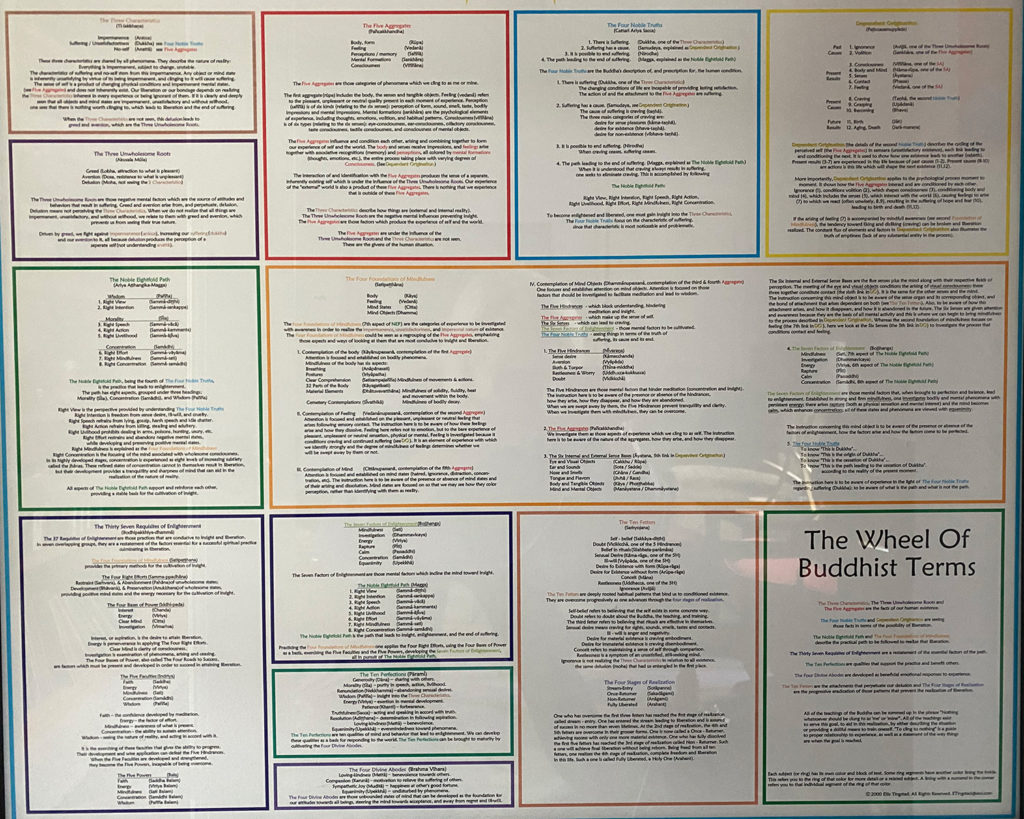
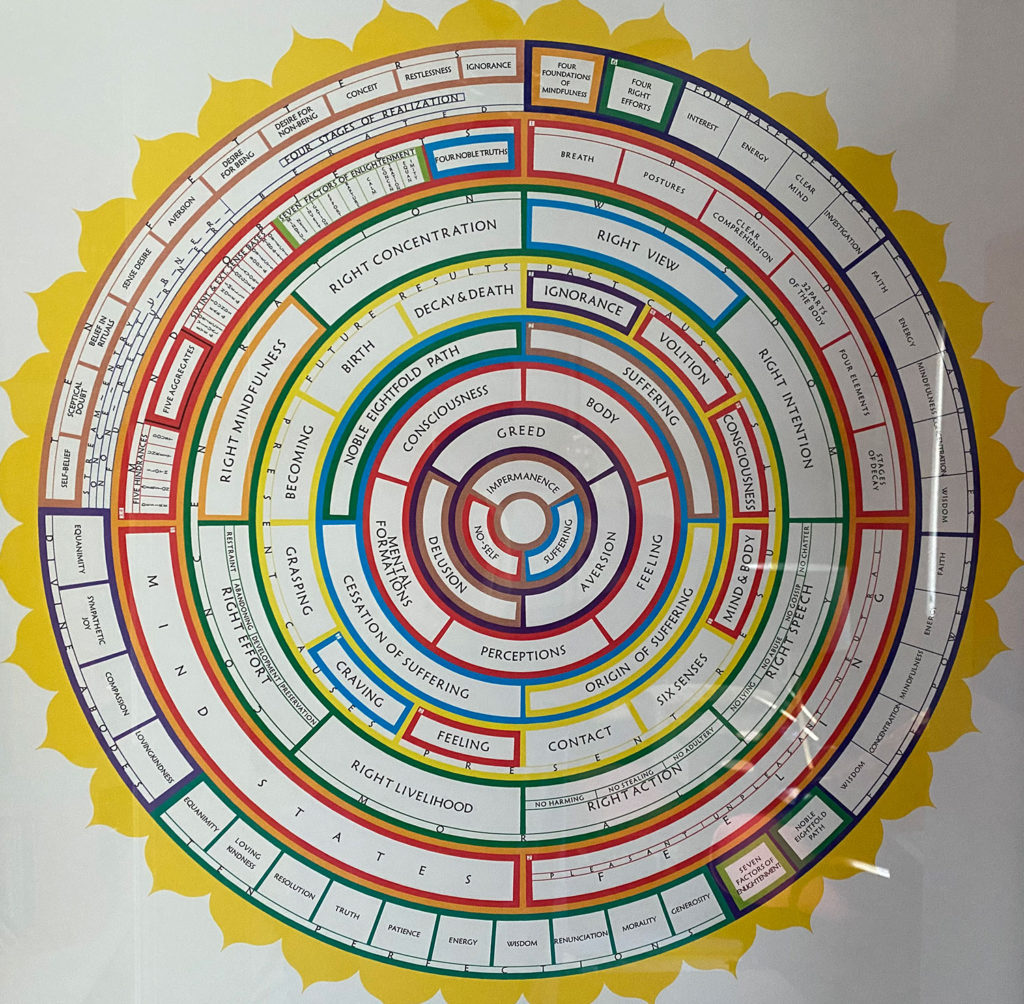
The Wheel of Buddhist Terms

Categories
Dharma

Mindfulness

“Mindfulness is centrally important on the path, and is said to be always helpful.

…simple mindfulness practice is limited in terms of the depth of reification it can dissolve; and as we develop the different practices we will come to understand exactly why this is.

Despite these limitations, though, naturally woven in to basic mindfulness practice are certain features that do make it a way of looking which, to a degree, both lessens fabrication and exposes some reification. It is in these ways in particular that it can help us realize a modicum of emptiness.”

“First, our investigations around all this need to be sensitive, and probably delicate. The whole area of emotional healing and emptiness is complex, and it asks of us not only great kindness, but also great courage, intelligence, and integrity.”

“Second, I am not suggesting that bare attention is always a better, or even a truer, way of looking than some of those that involve more psychological complexity. Although it can often be immensely helpful, bare attention is also just another way of looking, and one that it would be limiting and unwise to attempt to restrict oneself to continuously.”

Seeing that Frees – Rob Burbea

Categories
Dharma

Internally & Externally

An excerpt from Mindfulness by Joseph Goldstein

“Contemplating the body internally seems obvious; it is mostly how we practice. It is the present-moment awareness of what arises in the body — it might be the sensations of the breath or of different sensations arising throughout the body, such as heat or cold, tightness or pressure. But what does contemplating the body externally mean? There are some interesting aspects here that meditation practitioners don’t often make explicit.

Contemplating the body externally can mean being mindful of the bodily actions of others when they draw our attention. Instead of our usual tendency to judge or react when we see other people doing something, we can rest in the simple mindfulness of what the other person is doing. We can be mindful that they are walking or eating, without getting lost in our own thoughts of how fast or slow, mindful or careless they might be. An ironic and useless pattern that I’ve noticed on my own retreats is that my mind comments on someone not being mindful—or at least not appearing to be in my eyes—all the while being oblivious to the fact that in that very moment I’m doing exactly what it is I have a judgment about: namely, not being mindful! It usually doesn’t take me long to see the absurdity of this pattern and then just to smile at these habits of mind. It’s always helpful to have a sense of humor about one’s own mental foibles. By practicing this simple external mindfulness, we protect our own minds from the various defilements that might arise.

Although attending to the breath is mostly internal, the instruction to be mindful of the body externally could be particularly helpful on retreat when someone else’s breath may be loud and disturbing. At those times, being mindful of another’s breath—whether it is in or out, long or short—can actually be part of our own path to awakening.

Being mindful of the body externally has another advantage. Have you noticed that when you’re mindful of someone else moving very carefully, without distraction, that you yourself become more concentrated? This is one reason the Buddha suggested that we associate with those who are mindful and concentrated: it’s contagious. In this way, our own practice becomes a real offering to our fellow practitioners.

The last part of this instruction is to contemplate both internally and externally. Anālayo suggests that this is not just a simple repetition, but rather reflects a more profound understanding that we should contemplate experience without considering it to be part of one’s own experience or that of another, but just as an objective experience in itself. Being mindful internally, externally, and both reminds us of the comprehensive nature of mindfulness practice—to be aware of whatever there is, whether it is within us or without. And, in the end, to go beyond this division altogether.”